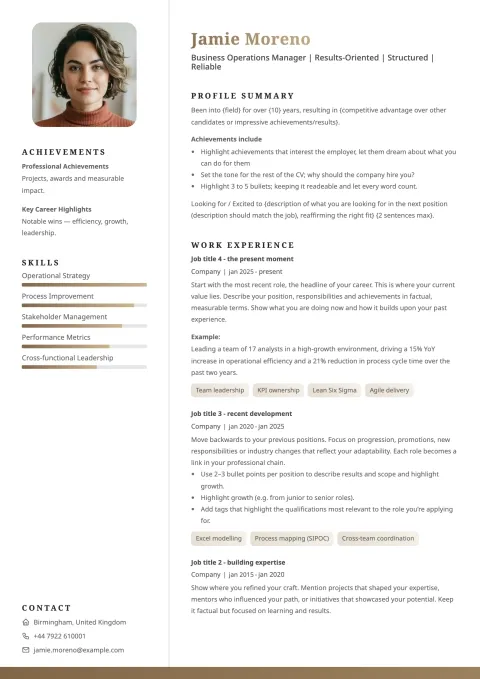


Let’s start with a simple scenario. Two candidates apply for the same role. Same education. Same years of experience. Same skills on their CV. Two weeks later, the recruiter remembers only one of them. Not because he or she was objectively better. But because this candidate left a more profound impression. This is where personal branding enters the room. Not the Instagram filter version, not just writing a random inspirational quote under your name, but real personal branding. The invisible thread that ties your CV together and makes a recruiter think: ‘I know what kind of professional this person is’.
Why personal branding matters on your CV
Your CV is not just a summary of facts. It is a positioning document. A signal system. A promise. And similar to brands in the real world, consistency beats creativity every single time.
Your CV is much more than a paper or pixels. It’s a mini-billboard of you. It communicates what makes you different, valuable, and trustworthy.
If a recruiter could only keep one memory from your application, it has to be something that your friends or family would call ‘typically you’.
Branding isn’t some fluffy talk, it’s psychology. Professor of Marketing Kevin Lane Keller created the Brand Equity model. This model shows that strong brands are built on identity, meaning, response, and relationships.
Your CV can do the same for your career:
- Identity: who are you?
- Meaning: what do you bring to the table?
- Response: how do you make recruiters feel?
- Relationships: how do they picture you fitting in?
→ Think of it as turning your CV into a personal commercial: short, punchy, and impossible to ignore.
Mental frameworks
Scientific backgroundTo create a strong personal brand, it’s important to know how recruiters perceive a CV. They don’t read CVs in a way they read a book, but they interpret CVs through mental shortcuts.
Cognitive psychology calls these ‘schemas’: mental frameworks that help people organise information quickly.
According to schema theory from psychologist Frederic Bartlett, people understand new information by fitting it into existing mental patterns.
When information fits neatly, it feels trustworthy. When it doesn’t, it creates friction.
So, when it comes to your CV, it means that the recruiter continuously matches your data with its internal question: ‘What kind of professional is this?’.
Research on signal consistency shows that when signals align, people perceive higher competence and credibility. This means that:
- A CV with a clear personal brand reduces uncertainty
- Reduced uncertainty increases trust
- Trust increases interview invitations
→ In other words: branding is not decoration. It’s risk reduction for the recruiter. Having a matching personal brand makes you a safe choice.
How recruiters read personal brand signals in your CV
Recruiters may not literally think ‘oh, wow, this candidate has a very strong personal brand’. However, unconsciously their brains are doing that work automatically.
A study on person perception and coherence shows that people form holistic impressions rather than analysing traits separately. In other words: we don’t add up bullet points when we assess people, we automatically create a story around a person.
So, when recruiters scan your CV, they’re subconsciously asking themselves:
- Does this person feel focused or scattered?
- Do their choices make sense together?
- Can I easily explain this candidate to a hiring manager?
Your personal brand signals show up in:
- What you choose to include (and, of course, what you exclude)
- The language patterns that you repeat
- The balance between facts and interpretation
- The way achievements are framed
→ Think of your CV as a playlist at a party. If people are going wild to hip hop music all night long, one misplaced slow ballad can ruin the vibe. Not because that ballad is a bad track, but because the flow is ruined and the evening loses its coherent vibe.
Ethan is a recruitment manager for a logistics firm in Manchester. He reviews around 60 CVs a day. He explains that personal branding on a CV is not about being unique at all costs.
It’s about being clearly positioned in the recruiter’s mind.
‘The strongest CVs make my job easier. I can summarise them in one sentence. Like: “She’s an operations specialist who thrives in complex environments.”If I need five sentences to frame a person, something is a little off.’
Now that you understand how your CV communicates who you are, it’s time to put it into practice. There is no one single way to do perfect branding, but here are some useful building tools to create a consistent and strong CV.
The following exercises will help you turn insights into a clear, coherent, and memorable personal brand.
→ In a stack of 100 CVs, you want yours to be remembered. The following tools and exercises will show you how.
Sidenote: these exercises are for everyone! Also if you’re still a student. Also if you’re just starting your career. And also if, for whatever reason, you don’t have too much work experience.
When the exercises talk about ‘job title’, you can read that as ‘(law/history/medical/etc.) student’. If the exercise names ‘work experiences’, you can read that as ‘study projects/extracurricular activities/sports achievements’ and so on.
→ The exercises are not about the exact titles, they are about how you brand yourself. And particularly for a student or starter, this is very useful. So don’t feel left out, but rather very welcome!
Define your professional identity (who you are in one sentence)
Your professional identity is not just a job title. It’s your angle, a punchline of who you are at work. The clearer you state your professional identity, the better recruiters perceive your competences.
This makes perfect sense when you compare the following identities:
- ‘Project Manager’
- ‘Project Manager specialising in complex stakeholder environments’
Same role. Different signal.
Nadia, a policy advisor from Brussels, opens her CV with: ‘Policy advisor translating EU regulation into workable national frameworks’.
In the lines that follow, she briefly highlights her experience working with both EU institutions and national ministries, acting as a bridge between policy design and real-world implementation.
Recruiters immediately understand her value.
Exercise 1: Turn your job title into a clear CV positioning statement
Most CVs fail before they are even read. Not because the experience is weak, but because the recruiter can’t immediately answer one simple question: ‘What kind of professional is this.’
This exercise forces you to zoom out and distil your professional identity into something that sticks.
Once it’s read, the recruiter should be able to complete the picture.
Implicit personality theory
Scientific backgroundResearch in social psychology shows that people don’t form impressions trait by trait. Instead, once they perceive one defining characteristic, their brain automatically connects it to a whole network of related traits.
This process is known as ‘implicit personality theory’.
This means that a single line at the top of your CV already triggers assumptions about how analytical, reliable, structured, or people-focused you are. In other words. recruiters automatically associate additional traits with the words you choose. That initial interpretation influences how they read everything that follows.
Let’s have another look at the following identity statement:
‘Project manager specialising in complex stakeholder environments’
This candidate is not only signalling ‘project management’, but also activating a cluster of associated characteristics such as:
- diplomatic
- resilient under pressure
- culturally sensitive
- structured
- strong communicator
→ This shows the exact effect of a strong branding. You signal the recruiter a lot about yourself, even without even naming those words explicitly in your CV.
Let’s start.
Open a blank document or notebook. Write down your current role or job title.
Add one specific differentiator:
- what makes you different from others with the same title?
- In what context, environment or type of challenge do you excel?
Write 3 to 5 alternative versions, each from a different angle:
- One focused on expertise (skills, sector knowledge)
- One focused on impact (what you help organisations achieve)
- One focused on style (how you work with others)
Reflect:
- Which version gives the clearest signal of your value?
- Could a recruiter summarise you in one sentence after reading this line?
→ Bonus challenge: ask someone who knows your work (but is not in HR) to read your headline and answer one question only: ‘What kind of professional do you think this person is?’ Refine your headline until their answer matches your intention.
Create a consistent career story
Strong CVs have an internal logic. Weak ones feel like a list of unrelated events, jumping from one role to the next with no connection.
Narrative psychology shows that humans understand careers as causal stories, not timelines.
In other words: we make sense of people by finding patterns and a common thread in what they do. So ask yourself:
- Why does my next role logically follow the previous one?
- What connects my choices?
- Even if my roles are very different, what common thread ties them together?
In case of a career that is a patchwork of all different experiences, it may be an extra challenge to glue these all together.
If you genuinely enjoy different kinds of work: focus on the underlying theme, skill set, or type of impact that links them. For example:
- Ann-May loves both marketing analytics and creative campaign design. Her thread: ‘Driving measurable results through creative insight.’
- Younes has been a teacher, a freelance writer, and a project coordinator. His thread: ‘Communicating complex ideas to diverse audiences.’
→ The key is framing. Each role highlights how it contributes to the overarching theme, rather than being an isolated experience.
Tomás, a data analyst from Lisbon, frames each role around increasing complexity of data problems, rather than job titles alone.
Even though he worked on marketing analytics, finance modelling, and public policy projects, the narrative thread is clear: ‘I thrive on solving progressively complex data challenges.’
His CV reads as growth and purpose, not hopping between unrelated jobs.
Exercise 2: Turn your experience into a clear career story
Many people worry that their CV looks too messy or all over the place. In reality, variety is not the problem, a lack of framing is.
Recruiters don’t expect a perfectly straight career path, but they do expect a story that makes sense.
This exercise helps you uncover the invisible thread that already runs through your choices, even if you never consciously planned it that way.
- List all your roles in chronological order. For each role, note:
- What kind of problems you worked on
- What type of impact you had
- Look for patterns across roles:
- Repeated skills
- Similar types of challenges
- A consistent kind of contribution
- Write one sentence that captures your narrative thread.
- Example: ‘I help organizations turn complex information into clear decisions.’
- Revisit 3–5 bullet points in your most recent role and adjust them so they clearly reinforce this thread.
- Reflect:
- Does your CV read like a journey, or like a collection of unrelated jobs?
- Which role feels hardest to connect, and how could you reframe it?
→ Bonus challenge: pick one experience that feels off-track (a side project, career switch, a hobby or a non-obvious role). Write one sentence explaining how it fits your thread. If you can do that convincingly, it belongs on your CV. If your thread or brand is all about bringing people together, it’s totally ok to mention at the hobby section that you’re the captain of your sports team.
How to reinforce your story
It is very understandable if ‘revisiting’ sounds easier said than done, hence these two examples:
Example 1: ‘Turning complex information into clear decisions’
- Prepared weekly reports for senior management
- Analysed performance data
- Supported decision-making processes
- Translated complex performance data into concise weekly insights for senior management
- Analysed multi-source datasets to clarify trends and trade-offs
- Enabled faster decision-making by presenting data-driven options in clear summaries
Example 2: ‘Driving alignment between stakeholders’
- Organised meetings with internal teams
- Worked with external partners
- Managed project timelines
- Facilitated cross-functional meetings to align priorities between internal teams
- Acted as a liaison between external partners and internal stakeholders
- Managed project timelines to maintain alignment across competing interests
→ Notice how the ‘before’ looks like some random bullets, while the ‘after’ glues all of your experiences nicely together as if you chose all your steps very intentionally.
Use language that strengthens your personal brand
People often underestimate how much tone and phrasing shape perception. The words you choose don’t just describe what you did, they communicate how you operate, your confidence, and even your style of working.
This is what we call your verbal fingerprint: the patterns and rhythms that make your CV sound like you.
Linguistic research on agency language shows that active phrasing increases perceived leadership and competence.
Passive phrasing, on the other hand can unconsciously signal hesitancy or lack of ownership.
To make this a bit more clear, let’s have a look at the examples below:
- ‘I was involved in coordinating and I have been given many tasks of responsibility…’
- I coordinated… and was responsible for…’
→ Your brand thrives by using active verbs. Both sentences describe the same achievement, but the second version communicates more ownership, initiative, and impact. Recruiters don’t consciously notice the change in verb, but they feel it.
Your language patterns make your CV more recognisable and memorable. When you consistently use active and bold language:
- It signals reliability and competence
- It strengthens the narrative thread of your personal brand
- It builds a subconscious impression of professionalism and confidence
Passive versus active
People easily intend to write in passive language. It may give a sense of humbleness or they feel that more words ‘tell more’, The effect, however, is usually the opposite.
Emma, a HR coordinator from Bristol, had a close look at her CV.
It used to have statements like this:
- ‘I was responsible for preparing the monthly report, was involved in coordinating the team’s weekly meetings and I was tasked with reviewing all client communications.’
She edited this sentence to a more active language pattern and it turned out like this:
- ‘I prepared the monthly report, coordinated the team’s weekly meetings and reviewed all client communications.’
→ Notice how the second version shows more ownership and confidence, even though the factual content is identical. The passive version feels distant and less engaging, while the active version communicates clarity and initiative.
Exercise 3: Make ownership visible
Your CV may describe impressive work, yet still sound strangely flat. Often, the issue isn’t just about what you did, but also about how you talk about it.
Small language choices quietly influence how confident, capable, and competent you appear.
This exercise is about making your ownership visible. Without exaggeration and without too much ego, but just through sharper phrasing.
- Select 10–15 bullet points from your CV.
- Highlight all phrases that are passive, vague, or indirect, like ‘supported’, ‘assisted with’, ‘was allowed to’ or ‘was involved with’.
- Rewrite each sentence using active verbs only, keeping the content exactly the same.
- Reflect:
- Which version sounds more confident and clear?
- Which sentences became shorter and stronger just by changing the verb?
→ Bonus challenge: create a short list of 5–7 verbs that fit your professional brand, like for example ‘led’, ‘analysed’, ‘built’, ‘translated’ and ‘optimised’. Check whether these verbs appear consistently throughout your CV.
Back up your personal brand with proof
Branding without proof is not much more than just an empty statement or opinion. Vague achievements like ‘improved processes’ don’t tell the recruiter anything, they don’t prove your brand.
Specific evidence increases trust far more than general claims: show them, don’t (just) tell them. Evidence turns your brand from a slogan into data that are credible. So, if you brand yourself as:
- Strategic: then also show your long-term impact
- Analytical: then also show decision-making based on data
- People-focused: then also show behavioural outcomes
Khalid, a HR Manager in Doha is a strong people manager. He has a charm to maintain good relationships with people of all kinds.
So, his ‘brand’ is: people manager/relationship builder. To support this claim, he needs adequate data. Look at the options below:
- ‘I built and maintained key client relationships, resulting in a 95% retention rate and repeated contracts across three regions in Central Africa.’
- ‘I analysed our marketing data and increased the quarterly profit by 23%’
→ The first sentence directly shows impact on relationships, which is Khalid’s personal brand. The second sentence is impressive but it only shows financial results and analytical tasks. It does not prove that Khalid excels at relationship-building.
Exercise 4: Make your personal brand credible
Many CVs contain strong claims and impressive numbers but they don’t necessarily reinforce each other. The result is confusion: the recruiter sees achievements, but doesn’t know what they are supposed to prove about you.
This exercise helps you test your CV: does your evidence actually support the professional identity you’re presenting, or is it just impressive noise?
- Write your personal brand in one line, like ‘people-focused leader’ or ‘analytical problem-solver’.
- Go through all your CV bullet points and categorise them as:
- Clearly supports my brand
- Impressive but unrelated
- Interesting but irrelevant
- Rewrite at least three bullet points so that they clearly support your brand using concrete outcomes or evidence.
- Reflect:
- Do your strongest metrics actually reinforce your positioning?
- Are you including data because it is impressive, or because it proves your point?
→ Bonus challenge: take one strong but mismatched metric. Like ‘revenue growth’ and rewrite it so it does support your brand. Think of linking growth to team development, customer retention, or decision-making.
Final thoughts: your CV is your personal billboard
Your CV is more than a summary of roles, it’s your personal brand in action. Like Nike, Coca Cola or Ford Mustang, consistency, clarity, and memorable signals make you stick in people’s minds.
Key reminders before you hand in your CV:
- Identity: make it clear who you are professionally
- Consistency: every element should reinforce that identity
- Language: make your CV sound active and vivid
- Proof: achievements + metrics = credibility
Imagine a recruiter scanning 100 CVs in a single morning. Which one would they remember? Which one makes them enthusiastic?
Big chance it’s the one that’s clean, confident and shows clear evidence. It’s the one that not only tells a cohesive story, but also signals exactly what that sector values.
There is always that one CV that specifically sticks to their brain. And after all these exercises, it may as well be yours.
Recap
- Your CV is more than data: it’s a story of who you are and what you stand for
- Every word and layout choice sends a signal about your professional identity
- A strong CV brand makes you recognisable instead of interchangeable
In the next chapter you’ll discover…
- Why a “strong” CV still gets ignored, and how small tweaks can completely change the outcome
- How to instantly show recruiters you’re the right fit (without changing your actual experience)
- The exact way to align your CV with a job description so it passes both ATS and human scans
→ Go to the next chapter: How to tailor your CV to the job