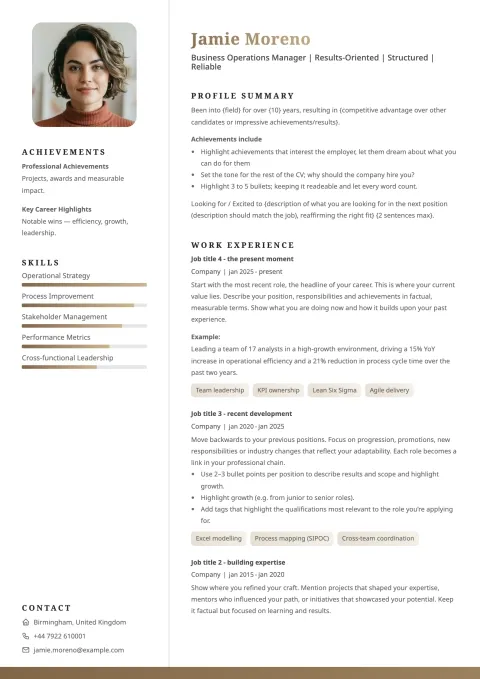


You must recognise this frustration. You apply to multiple roles that all feel like a good fit. You use the same CV because your experience hasn’t magically changed overnight. Still, one application leads to an interview, the others to silence. Not because you suddenly became less qualified, but because your CV wasn’t tailored to the job. Tailoring is not about inventing experience. It’s about highlighting what matters and downplaying what doesn’t. And also about framing the same reality differently, depending on who is reading. Think of it as adaptive communication, not manipulation. The best candidates don’t change who they are, they change what they emphasise.
Why tailoring your CV to the job matters
Recruiters and Applicant Tracking Systems (ATS) always evaluate your CV in context. Never in isolation.
A CV that shines in one environment can fall flat in another, even if the content is identical. Relevance beats completeness every time.
Think of it like wearing your new custom-made tuxedo to a beach party. It’s impressive, but just not the right place and probably not getting the attention it deserves.
Psychological research on person–environment fit shows that people are evaluated more positively when they appear aligned with the specific demands and values of a context.
Recruiters unconsciously ask themselves: ‘Does this person fit here?’ Not: ‘Is this person good in general?’.
Tailoring your CV to the job works because:
- It reduces cognitive effort for the recruiter
- It increases perceived fit
- Perceived fit increases hiring intention
→ So, in short: tailoring your CV is not decoration. It’s relevance engineering. And yes, a little tailoring goes a long way.
Selective attention
Scientific backgroundRecruiters don’t read your CV word by word, they filter it. In cognitive psychology this is called ‘selective attention’. It means that people only notice information that matches their current goal.
In case of a recruiter it means: finding a suitable and fitting candidate for the job.
A job description acts as a filter. When a recruiter or ATS reads (or better: scans) your CV, your document is constantly evaluated against one question: ‘Does this person help me fill this specific role?’.
If the answer is unclear, the CV is binned. Even if your experience is objectively impressive.
→ Tailoring means pre-filtering your CV for the recruiter.
How recruiters and ATS experience CV optimisation
Recruiters do not literally applaud keyword choices or clever tailoring, but they know or feel a CV is well optimised.
Just like you when you enter a room: you may not literally think that the colour on the wall perfectly matches that blanket on the couch, but still feel that a place is in harmony.
Both the ATS and the recruiter need to be satisfied. A recruiter needs to have the feeling ‘this candidate gets it’. The ATS needs to be convinced that you are relevant.
Research on processing fluency shows that people tend to like things more when their brain can process them easily. The smoother the processing, the more positive the feeling.
Elements that are logical, familiar, or well-structured feel more pleasant because they require less mental effort. When something feels easy to understand, it also feels more trustworthy.
→ In other words, quality doesn’t only live in the object itself, but in how effortlessly it can be processed by the reader. When something ‘flows’, our brain rewards it with trust. A tailored CV feels fluent. A generic CV feels noisy, even when the content is strong.
Ebba is a senior recruiter in Stockholm for a healthcare agency. She explains that when a CV has a similar language as the vacancy, it becomes more trustworthy.
She tells that candidates shouldn’t literally copy the vacancy text, since that would actually come across as fake. But she needs to see that a candidate understands the role and understands what a recruiter needs for that.
‘I don’t have time to guess where an employer would add value, it has to be clearly stated. I had two candidates apply for the same role in product operations, both with similar experience. One CV described general achievements like “worked with stakeholders” and “improved processes”. The other CV said “aligned stakeholders across time zones” and “improved handovers between product and operations”. I could more easily picture the second candidate function in our team, so I invited her instead of the other one. I will never hundred percent know if that was the right decision, but I can only go by the information that I get.’
→ A good CV doesn’t necessarily shout how tailored you are. It quietly removes doubt, provides clarity and makes you feel like a natural fit.
Step 1: Tailor your CV to the job description
The first layer of optimisation is the role itself. Not the company. Not the culture. The role.
Different roles value different indicators, even within the same field. They don’t just differ in responsibilities, but also in the priorities and ways of thinking they require.
Many candidates assume that if their experience is strong enough, it should speak for itself. In reality, experience is mute until it is framed.
A recruiter doesn’t ask: ‘What has this person done?’ but rather: ‘Is this the kind of experience that solves my type of problems?’
That is where job-specific tailoring starts. Same experience, different emphasis.
Let’s have a look at an example.
Sofia is a business analyst with five years of experience. She is applying for a strategy consultancy role but is also interested in a vacancy for an internal operations role.
She wants to frame her experience in such a way that it adapts to both jobs. First she tries to imagine what the recruiter or ATS looks for. Then she creates the perfect framing.
| Vacancy | Strategy consultant | Internal operations |
|---|---|---|
| Sofia’s expectation of the role: | Untangling ambiguous problems, forming quick hypotheses, help senior leaders with complex decisions | Make things work day after day, focus on execution, implementing stable processes |
| Indicators and ways of measurement: | Long-term implementation, clarity of thinking, sharp analysis | Process efficiency, stakeholder satisfaction, implementation rate |
| Bullets on Sofia’s CV: |
|
|
Exercise: Match your CV to job requirements
Before you start rewriting, take a moment to step into the recruiter’s shoes. What are they really looking for? Which aspects of your experience will make them sit up and say: ‘Yes, this person understands what we need’?
This exercise helps you tune your CV so your experience speaks the same language as the role.
Take one vacancy you are genuinely interested in.
Highlight:
- Core responsibilities
- Repeated keywords
- Implied requirements, such as: speed, accuracy, leadership, innovation, stability
The words you highlighted in step 2 are not just keywords. Think of the highlighted words as evaluation criteria. Impact, method and context are how you translate those criteria into proof.
So, select one role from your CV and rewrite 3 bullet points:
- One focused on impact: show what changed because of you
- One focused on method: tell how you approached the work
- One focused on context: elaborate on environment, stakeholders, constraints
Reflect:
- Would a recruiter immediately see the link between this role and the vacancy?
- Does each bullet clearly answer the question: ‘Why is this relevant for this job?’
→ Think of your CV as a menu: the ingredients are the same, but you highlight the dishes that you think the chef of this role is craving.
Emma, a Product Coordinator from Minnesota, framed it like this:
- Impact: Improved project delivery timelines by 25% through streamlined planning and coordination
- Method: Introduced weekly sprint reviews and cross-team check-ins to improve alignment
- Context: Managed projects across three departments with competing priorities and tight deadlines
→ This way, you’re not just repeating responsibilities. You’re showing results, thinking, and environment, which together create a much stronger and more credible story.
Step 2: Tailor your CV to the industry or sector
Different sectors reward different behaviours. Sociological research on institutional logics shows that industries develop shared ideas about what the ideal sector skills look like.
This is very important to keep in mind, because what is praised in one sector may be ignored in another. Let’s have a look how to adjust the same experience to different sectors.
Michael, from Auckland, has eleven years of experience as a project coordinator. He is open to work in both the public and corporate world, but he does realise this needs a proper CV modification.
His sister pointed out another vacancy in the non-profit world, so he also took that option into account. After some editing he framed his numerous years of experience in three different ways:
Public sector CV:
- Ensured policy compliance across multi-stakeholder projects
- Coordinated timelines within strict regulatory frameworks
- Documented decisions to support transparency and accountability
Corporate CV:
- Accelerated project delivery in a fast-changing environment
- Balanced competing priorities across commercial teams
- Improved workflow efficiency to meet aggressive growth targets
Non-profit CV:
- Coordinated mission-driven projects with limited resources
- Aligned diverse stakeholders around shared social goals
- Maintained delivery under budget and capacity constraints
Sidenote: sector boundaries are not always universal. What is considered public, corporate, or non-profit can vary per country.
For example, healthcare in the United Kingdom is largely part of the public sector through the National Health Service, whereas in the United States it is often delivered through private or corporate organisations.
This means that the same role may need to be framed differently depending on the local context. Being aware of how sectors are structured in your target country, helps you position your experience in a way that feels immediately relevant and familiar to the reader.
Exercise: Align your CV with sector expectations
Not every organisation values the same things. What makes you a star in a tech start-up might make you look reckless in a government agency.
This exercise helps you spot those subtle differences and sharpen your bullets so they ‘speak the right sector language’. See it as giving your CV a little wardrobe change: same person, different outfit. And perfectly suited to the occasion.
This exercise helps you to translate your experience into signals that make sense within a specific sector.
Identify the sector of your target role.
Write down what that sector typically values:
- Speed vs accuracy
- Innovation vs compliance
- Individual ownership vs collective process
Review your bullet points and mark:
- Which bullets clearly fit this logic
- Which feel neutral
- Which work against it
Rewrite at least 3 bullets so they better align with sector values.
Reflection:
- Does your CV sound like it belongs in this sector?
- Could it accidentally signal the wrong environment?
→ Approach your CV like a Swiss Army knife: the tool is the same, but each sector favours a different blade.
Step 3: Tailor your CV to company culture
Company culture is rarely stated explicitly, yet it is often signalled quite clearly. Most job descriptions don’t say: ‘We value autonomy but expect long hours’, or ‘We love innovation, as long as it’s approved by three committees’.
And yet, everyone who works there knows exactly how things are done.
Think of the first week in a new job. You haven’t read a single internal policy yet, but you already sense the culture.
Do people reply to emails at midnight? Is the meeting agenda a suggestion or a rule? Does the intern speak up freely, or wait until spoken to?
None of this is written down, but all of it is communicated.
Organisational culture
Scientific backgroundHumans read environments by cultural cues. Research on organisational culture cues shows that people presume a culture by the use of language, structure, and tone, rather than via explicit statements.
We pick up signals from how things are phrased, what is emphasised, and what is quietly assumed.
The same applies to CVs. When you read a vacancy, you are not just reading requirements, you are reading behavioural expectations.
Different sectors reward different ways of working. Sociological research on institutional logics shows that industries develop shared norms about what is considered legitimate, competent, and professional behaviour.
In other words: what counts as a good fit in a closed-knit start-up may raise eyebrows in a conservative public institution and vice versa.
→ Cultural alignment in your CV is not about copying company slogans or forcing a personality fit. It’s about recognising which behaviours are quietly valued, and making sure your CV signals that you understand the environment you are applying to.
You find the cultural cues in:
- Job ads
- Company websites
- Leadership messaging
- How success is described
So, a job vacancy emphasising ‘ownership’, ‘entrepreneurial mindset’ and ‘comfort with ambiguity’ breathes a different company culture than a job advertisement that speaks about ‘procedures’, ‘consistency’ and ‘clear reporting lines’.
→ Make sure your CV echoes these values, without copying phrases. Organisational culture is usually breathed quietly. The art is to quietly ‘breathe’ it back.
Amina, a branding manager from Lima, reads a vacancy that highlights ‘ownership’ and ‘fast decision-making’.
She tweaked her CV bullets to show she led campaigns independently and made rapid strategic calls.
This way the recruiter can instantly see she would fit the culture.
Before:
- ‘Coordinated marketing campaigns with internal teams.’
After:
- ‘Independently led multi-channel campaigns, making strategic decisions under tight deadlines.’
Exercise: Adjust your CV to match company culture
Company culture isn’t about dress codes or aesthetics. It’s not about hoodies versus tailor suits, or beanbags versus office chairs.
It’s about how decisions are made, how people behave under pressure, and what gets rewarded.
This exercise helps you decode those signals and subtly adjust your CV so it feels at home in the organisation.
Read between the lines.
Visit the company’s website and carefully read the job ad. Don’t just scan for requirements, also pay attention to tone and choice of words. Highlight words that describe:- Behaviour: words like ownership, collaboration, accountability
- Attitude: terms like entrepreneurial, people-focused, result-driven
- Ways of working: indicators like structured, fast-paced, autonomous
→ If a word appears more than once, it’s probably important.
Adjust your signals:
Revisit your CV and make small but meaningful tweaks. Focus on:- Verb choice: ‘initiated’ versus ‘executed’, ‘challenged’ versus ‘followed’
- Achievement framing: ‘risk-taking and learning’ versus ‘reliability and consistency’
Reflection:
- Would your CV feel comfortable within the organisation?
- Does it reinforce the cultural signals, or quietly pushes against them?
→ Your CV is like a first impression at a dinner party: the same guest can shine or fade. It all depends on how well he or she understands the hosts and the vibe.
Step 4: Optimise your CV for ATS (without losing your voice)
Applicant Tracking Systems (ATS) don’t judge your CV, they categorise it.
Think less in the lines of an interview panel but more in the idea of a barcode scanner at a supermarket: it sees patterns, not people.
Research on ATS screening shows that these systems rely primarily on keyword matching and structural consistency, not originality or creative wording.
This means that a beautifully written CV can still disappear if it doesn’t speak the system’s language.
At the same time, a CV that is written only for the system may pass the software, but fail the human eye and gut feelings.
Smart optimisation lives exactly in between.
How ATS systems read your CV
Scientific backgroundRecent research on document understanding shows that algorithms don’t read documents in neat steps.
They don’t first ‘read’ text and then ‘interpret’ it. They do both at the same time. Text, layout, position and meaning continuously inform each other.
A job title placed where a job title is expected is easier to recognise.
A responsibility written as a bullet under a role is easier to interpret. Context reinforces meaning. And meaning improves recognition.
→ ATS optimisation isn’t about adding more keywords to your CV. It’s about placing the right words in the right structure. Clear section headers, predictable layouts and well-labelled roles help the system understand what it is looking at.
Smart ATS optimisation means:
- Using role-specific terminology that mirrors the vacancy
- Matching job titles where appropriate, without overdoing it
- Keeping structure predictable and easy to examine
→ ATS optimisation should never override human readability. Your CV still needs rhythm, clarity, and a recognisable voice. Recruiters are not impressed by keyword bingo, they are impressed by people who make sense.
Haruto, an infrastructure technician from Hiroshima, finds a job advertisement for a big road construction in Tokyo.
He analysed the vacancy to assume the keywords the ATS would be scanning for. He added more relevant keywords to pass the system:
Before:
- ‘Worked on road maintenance projects with the local team.’
After:
- ‘Executed road maintenance and repair projects, ensuring compliance with municipal safety standards and deadlines.’
Exercise: Balance ATS keywords with human readability
In this exercise you learn to speak the system’s language without losing your own accent. The goal isn’t to write a CV that only a robot can read, but one that both algorithm and human can understand clearly.
You want your achievements, skills, and identity to be visible to the ATS and instantly meaningful when a recruiter opens the file.
This exercise helps you find that sweet spot where technical optimisation and personal storytelling meet.
Copy the vacancy text into a separate document.
Highlight essential keywords:
- Core skills
- Role-specific terminology
- Repeated concepts
- Check whether these keywords appear naturally in your CV:
- In your headline
- In your role descriptions
- In your achievement bullets
- Adjust phrasing where needed:
Replace synonyms with the exact term used in the vacancy if it still sounds like you
Integrate keywords into existing sentences rather than adding new ones
→ Don’t overdo it. Keyword stuffing feels unnatural and doesn’t do the job. Use key terms where they logically belong (headline, core skills, key achievements).
Avoid repeating the same word in every bullet point. It’s ok to use natural variation, as long as the core term appears at least a few times.
- Reflection:
- Does your CV still sound like something you would say?
- Would a recruiter enjoy reading this after scanning it for 7 seconds?
- If you read one bullet out loud, does it feel human or robotic?
→ Think of your CV as a tool: it must fit the machine, but also feel solid in human hands.
Checklist: tailor your resume to every job
Tailoring your CV is not about tricking systems or pleasing everyone. It’s about showing respect for context. Each role, sector, and organisation asks a slightly different question.
A strong CV answers the right question, clearly and convincingly.
Before you hand in your CV, have this last check:
In a pile of strong candidates, relevance is often the deciding factor.
And once you master tailoring, your CV doesn’t just say ‘I am qualified’. It signals: ‘I belong here’.
Recap
- Your CV is not a one-size-fits-all document: it’s a context-driven testimonial
- Every vacancy needs a different CV version that breathes ‘the ideal candidate’
- Optimising your CV is not lying or faking, it’s just the perfect translation of ‘you’
In the next chapter you’ll discover…
- Why your CV doesn’t need to be perfect to impress recruiters
- How to explain career gaps, switches, or limited experience with confidence
- Practical examples that turn common weaknesses into compelling strengths
→ Go to the next chapter: How to fix your imperfect CV