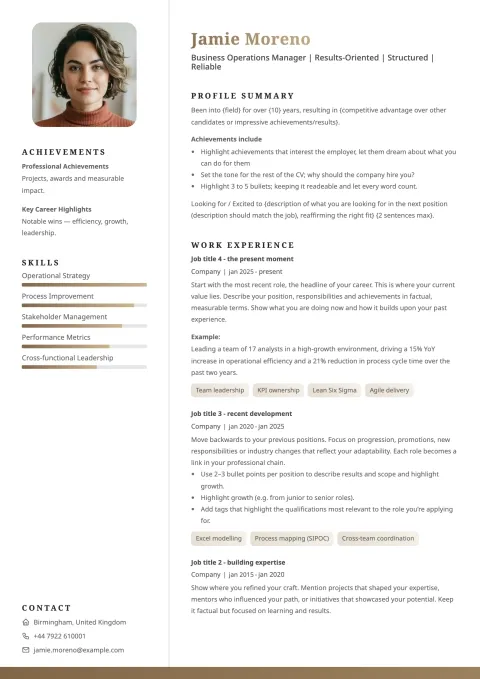


Imagine this. You have a fantastic product, namely: you. This product comes with years of research and development. Think of your education, work experience, sleepless nights and Friday afternoon brainstorms. You know this product works and you know it adds value. But if you don’t package it properly, it never even makes it to the shelf. This is exactly what happens with your CV. Your CV format is not just decoration. It’s strategy. It’s architecture. It’s neuromarketing wrapped in fonts, whitespace, and bullet points. Recruiters don’t just read CVs: they scan, skim and sort. This article dives into the best CV format for your dream job. How do you choose between chronological, functional, hybrid, infographic or I-just-made-this-compilation-at-2am-formats? And how do you use neuromarketing hacks to make recruiters want to meet you?
Why choosing the right CV format matters more than you think
Recruiters will not read your CV like they read a novel. They’ll glance for just a few seconds, squint, sip coffee and decide: yes or no. That’s it.
The structure of your CV is the scaffolding that supports that decision. If the structure collapses, the content never gets its chance to shine.
The human brain is wired for shortcuts. This study on cognitive fluency shows that people prefer information that looks easy to process. If your CV looks simple to digest, recruiters are more likely to believe your career story is easier to trust.
→ That means format = perception. The same content in a messy layout feels weaker than in a clean one. Think of it as serving a Michelin-star meal on a paper plate versus a porcelain dish.
A classic study by Jakob Nielsen on web usability shows that readers consume online information in an F-shaped pattern: headline first, subheadlines second, then down the left-hand margin.
Recruiters use the same pattern when scanning CVs. Your format either helps them follow this F-pattern or rather frustrates them until they toss it.
→ Think of your CV as a user interface. If recruiters can’t navigate it in seconds, they’ll abandon ship. The prettiest words won’t save you if they’re buried in clutter.
The art of packaging yourself
Here’s a thought experiment: imagine you’re shopping for coffee beans.
You don’t have time to research every package. You glance at the label, the colour, the typography. Before you’ve even tasted it, you’ve decided which one feels trustworthy or sophisticated.
That’s exactly how recruiters treat your CV format. Before they dive into your words, they’ve already judged you by the structure.
Your CV format isn’t decoration. It’s your label. It tells a story about you before they’ve read a single sentence. Clean? Organised? Sharp? Or cluttered, confusing, and a bit 2003 PowerPoint? That first second can make or break you.
Omar is a recruiter for a real estate company in Dubai. He handles hundreds of applications every week.
“All coffee beans look the same until you put them in the right bag. It sounds weird but it’s helpful if job applicants see themselves as a coffee bean. Applying for a job isn’t much different than knowing how to sell yourself. Your CV format is the packaging that makes me stop, look twice, and actually want to try what’s inside the bag.”
When Omar scrolls through CVs, he doesn’t have time to decode chaos. If the layout looks like a rushed Word template, his brain files it under ‘too much effort’.
But when the CV is sharp, clean, and structured, he’s drawn in, even before reading the first bullet point.
He compares it to walking into a café where the menu is clear, the cups are polished, and the aroma does the work.
Presentation sets the stage for trust.
The main CV formats (and when to use each one)
There isn’t just one ‘best’ format. Instead, there are hundreds of CV templates out there, but most fall into these six main categories: chronological, functional, hybrid, visual, narrative or portfolio.
Let’s map them out and unpack them.
1. The chronological CV format (the Netflix-style binge list)
“Press play and watch your career in reverse”
This is your career in reverse order. Latest role first, then scrolling back in time. Recruiters love it because it’s predictable, clear, and bingeable.
Perfect for traditional industries, but less forgiving if you’ve had plot twists, cliff-hangers, or employment gaps.
Suitable industries: banking, law, accountancy, public sector, academia.
Julien, a police officer from Lyon, uses a chronological CV to show his steady career progression: junior officer → detective → sergeant.
When the HR manager saw his neat reverse timeline, including his year-long training exchange in Berlin, she immediately appreciated the clarity.
For law enforcement, the sequence of roles and experience matters more than flair or storytelling.
2. The functional CV format (skills in the spotlight)
“Shine a torch on your superpowers”
Forget job titles. This format is about the pack of talents you have. Group your superpowers (such as leadership, data analysis, communication) into neat sections and shine a light on achievements.
Brilliant for career changers or people with patchwork experience. Traditional recruiters may frown though, because the timeline gets a little… fuzzy.
Suitable industries: tech businesses, creative industries, startups, NGOs.
Li Wei, a tech consultant from Singapore, once switched from teaching mathematics to coding enterprise software.
Using a skills-based CV, he grouped ‘problem solving’, ‘data analysis’ and ‘bringing clarity in complexity’ at the top.
His former career as a teacher became an extra asset: recruiters realised how he could explain complex concepts clearly to clients.
It proves that non-traditional paths can work brilliantly if framed right.
3. The hybrid CV format (the diplomatic peace treaty)
“Why choose sides when you can keep everyone happy”
When you don’t want to pick sides, this format gives you the best of both worlds: your skills and your experience. Headline your top skills at the start, then follow with your work history.
It pleases humans and algorithms alike. Just watch out: without clarity and discipline, it can read like an overstuffed suitcase at the airport check-in desk.
Suitable industries: marketing, tech businesses, project management, international business.
Ana, a marketing professional from Sao Paulo, combines her digital marketing achievements with a concise chronological work history.
She highlights successful campaigns at the top and then lists her roles from marketing coordinator → brand manager → marketing manager.
The hybrid format helped her land a regional leadership role because it satisfied both the ATS system and the human recruiter who wanted to see career growth.
4. The visual CV format (the career catwalk)
“Strut your stuff across the page”
Your career as a stylish runway: each job shines off the page like it’s Fashion Week: bold dates, icons, and sleek graphics.
Eye-catching for creative fields where design matters. Less ideal if the recruiter is a robot (Applicant Tracking System) with no appreciation for flair.
It can’t spot a Gucci heel from a Primark pump, so it might miss your achievements entirely.
Suitable industries: graphic design, UX/UI, media, creative agencies.
Sofia, a UX designer from Milan, created a visual timeline CV with icons for each major project.
Her timeline included a period as an art writer for a youth magazine. This was a surprising addition that made her stand out in interviews.
For creative industries, showing growth visually and sprinkling experiences, like engaging a young audience, makes the CV memorable.
5. The narrative CV format (the storyteller)
“Every career has a plot twist”
Less lists, more journey. You frame your career as a story of challenges faced, dragons slain and victories won. Your CV becomes a mini TED talk.
Works brilliantly for consultants, leaders, or entrepreneurs.
Just make sure you’re pitching your saga to the right audience. No need to spin heroic stories for a conservative bank recruiter who prefers facts in neat little bullet points.
Suitable industries: consulting, startups, leadership roles.
David, a sustainability consultant from Dublin, framed his CV as a journey: leading a renewable energy project from inception to completion, overcoming regulatory hurdles along the way.
By telling the story, he conveyed his leadership and problem-solving skills. He told his story with a lot of humour and a sense for collegiality.
Recruiters valued his narrative even more than the dates, and the story format allowed his unique career path and witty personality to shine.
6. The portfolio CV format (show-and-tell)
“Don’t tell me you can do it, show it”
Part CV, part exhibition. You sprinkle in real project snapshots, case studies or links. Recruiters don’t just read about your brilliance, they see it.
A dream for designers, writers and creatives. For accountants? Maybe less so. Unless you’ve made spreadsheets that belong in the Tate Modern (not even kidding). So go bold, or go home.
Suitable industries: design, photography, writing, architecture, film making.
Petrova, a graphic designer from Moscow, included mini case studies with screenshots in her portfolio-hybrid CV.
She also highlighted a meaningful collaboration: designing a toolkit for a health care centre to help their clients who suffer dementia.
Her portfolio allowed her to demonstrate creativity and impact outside her main client work.
Recruiters immediately saw her ability to deliver results in multiple contexts.
→ Ready to turn this into your CV?
You don’t have to start from scratch. Our free CV builder helps you quickly create a clear, recruiter-friendly CV using the formats mentioned above (chronological, functional, and hybrid). No watermark, no hidden fees.
Choose a free CV templateHow to choose the right CV format for your job
Exercise 1: Identify the best CV format for you
Let’s imagine you’re going to a party. The invite says: cocktail chic. You don’t show up in pyjamas, nor do you rent a full tuxedo with tails. You adapt to the occasion.
Your CV format is like your outfit, so take a moment to connect with what you just read. Out of the six CV formats, which two versions feel most like you?
Don’t overthink it, just note your first instinct. Circle it, highlight it, or jot it down in a notebook. This isn’t about the right choice yet, it’s about your gut reaction.
Look at the industry you’re applying to. For traditional fields, you might hesitate between chronological or hybrid, especially if you have strong extracurricular achievements.
In creative industries, a visual timeline could catch the eye, but the story format might also suit you if the role values writing and narrative.
For a tech start-up, you may doubt between a hybrid CV with punchy skills at the top or a portfolio format to showcase tangible projects or editing skills.
→ Ask yourself: does my story flow naturally in a timeline, or do I need to pull skills into the spotlight first? What outfit does my CV need? A lawyer wouldn’t show up to court in neon trainers. A graphic designer wouldn’t wow anyone with a Times New Roman Word document. Your CV format is your professional outfit.
Exercise 2: Compare CV formats and ATS compatibility
Now after your first reflection, let’s put the formats in perspective for a more profound side-to-side comparison. The matrix below summarises the pros, cons, suitable industries, and ATS compatibility of each format.
Think of it as a quick-reference guide that pulls together everything you’ve just explored, giving you a clear overview before you dive into applying the insights to your own CV.
| Format | Pros | Cons | Industries | ATS friendly? |
|---|---|---|---|---|
| Chronological | Clear, easy to follow, shows progression and stability | Highlights gaps: less flexible for career changers | Finance, law, public sector, academia | ✅ Yes |
| Skill-based / Functional | Focuses on abilities, great for diverse experience | May confuse traditional recruiters | Tech, creative industries, startups, NGOs | ✅ Yes |
| Hybrid | Balanced: skills + timeline, versatile | Can get cluttered and messy if too detailed | Marketing, tech, project management, international business | ✅ Yes |
| Visual | Memorable, shows growth visually | Poor for ATS: risky in conservative fields | Graphic design, UX/UI, media, creative agencies | ⚠️ Partially |
| Story | Engaging narrative: highlights leadership and impact | Too long if not concise: not ATS-friendly | Consulting, startups, leadership roles | ⚠️ Partially |
| Portfolio | Showcases work + results: highly impactful | Can overwhelm if not curated: not for all fields | Design, photography, writing, architecture, film making | ❌ No |
Now think of your own specific experience, target role, and context to make a more grounded and informed choice.
Please use a notebook for the following steps. Look at each format and ask yourself:
- Would this format show my strengths clearly?
- Does it suit the industry I’m applying to?
- Will it work with Applicant Tracking Systems (ATS)?
→ Think of context and audience, not just personal preference. For example: a police officer would usually pick chronological, but if he is now offering corporate bootcamps, a portfolio CV might work better. This way he can add pictures of his bootcamp or maybe a QR code that links to videos of his work. Conversely, a creative designer might swap a visual or portfolio CV for chronological if she is applying to a government role.
Aisha from London is applying for a UX Designer role at a creative start-up. She wants to join a small, fast-paced team where every project demands both design flair and solid user research skills.
Her CV needs to show creativity, technical competence, and the ability to make an immediate impact.
These are Aisha’s notes:
| CV Format | Suitable for me? | Why |
|---|---|---|
| Chronological | Maybe | Shows career progression, but freelance projects may be hidden |
| Skills-based | Yes | Highlights UX and design skills right away |
| Hybrid | Yes | Combines skills and brief work history, works for both ATS and humans |
| Visual timeline | Yes | Visually striking for creative industry, less ATS-friendly |
| Story-driven | Maybe | Tells project stories, but can be too long for ATS |
| Portfolio | Yes | Shows projects and outcomes, very visual, not ideal for ATS |
After this deeper reflection, you probably have a clearer, more justified choice of the CV format that best balances your strengths, audience expectations, and ATS compatibility.
Do you still have the two same favourites or did another option come to mind? Use your current two favourites for the next exercises.
→ Remember, there is no right or wrong. In reality you might even use all six formats for different employers during the same job search period. Even for similar roles. It’s all about context: making sure the ‘fit’ of your CV matches your message, your goals, and the work place you’re applying to.
Exercise 3: Test your CV format with real feedback
Nothing beats a good CV clarity test. Sometimes you’re too close to your own story to see what truly stands out.
Getting fresh eyes on your CV can reveal surprises, strengths you didn’t notice, and tiny tweaks that make a huge difference. Test your two different CVs on strangers with the 7-second scan.
- Create your CV in the two favourite formats you’ve chosen and print them (or save them digitally)
- Show them to three different people (ideally not close friends)
- Ask: which format makes me look stronger? More relevant? More memorable?
→ To get the best feedback it’s best to ask a person that works in a similar branch that you’re applying for. Your neighbour that’s a manager in banking may not be impressed by your graphic visuals, but that aunt in Australia that has an architecture office may be much more able to assess the value of your designing skills.
Exercise 4: Optimize your CV format using psychology
Now, if you want to hit bull’s eye with your CV, it’s important to understand how recruiters look at your CV.
Recruiters don’t just skim your CV. They make quick and instant judgements, based on how it’s visually presented and how information flows. Often before even reading a word.
Think of recruiter Omar shopping for coffee beans at 6pm in a supermarket: rushed, distracted, and based on labels.
This phenomenon of ‘thin slicing’ explains this. In a meta-analysis, Nalini Ambady and Robert Rosenthal (1992) demonstrated that people can form remarkably accurate impressions from very brief behavioural observations, sometimes in just a few seconds.
→ What does this mean for you? Recruiters’ brains are wired to pick up cues, patterns, and shortcuts before they consciously process your detailed experience. Understanding neuromarketing fundamentals helps you use the science of persuasion to your advantage and apply it to your personal branding.
Helpful neuromarketing principles
Scientific backgroundYou don’t need a neuroscience degree to outsmart recruiters, but knowing a few neuromarketing principles really helps to optimise your CV:
The primacy effect (what comes first, sticks)
Cognitive psychology shows that people remember the first thing they see better than the rest. That’s why the top third of your CV is prime real estate. If the first thing a recruiter sees is a weak summary, you’ve wasted the golden spot. Put your strongest, most relevant selling points at the top. Start with your impact.The Von Restorff effect (distinctiveness wins)
People remember things that stand out. Use bold headings, whitespace, and even a splash of colour (if industry-appropriate) to guide attention.Cognitive load theory (don’t fry their brain)
Recruiters have limited mental bandwidth. If your CV is cluttered, their brain short-circuits. Keep it clean, minimal, and structured.Mirror neurons (make them feel you)
Tell micro-stories that create empathy. Recruiters aren’t hiring a robot, they’re hiring a person. A single human detail can anchor their memory.
Now take your chosen CV format and run this audit to put some real nice icing on the cake:
- Top third: does it grab attention? Does it scream relevance? Or is it mumbling your hobbies from 2009?
- Distinctiveness: is there one element that makes it memorable? A punchy phrase, a standout stat, or even a subtle design twist?
- Cognitive load: can someone scan it without feeling dizzy? Or have you packed it like you woke up ten minutes before check-out in a hotel?
- Emotion: is there a line that makes them think: I want to meet this person?
How to choose the best CV format: key takeaways
Your CV format is the frame around your story. It either makes the picture shine or distracts from it. In this article you’ve explored how different structures highlight skills, experience, and personality in unique ways.
To wrap up, here’s a quick guide to the main styles and the kind of impact they have:
- Chronological = steady growth
- Functional = transferable skills
- Hybrid = best of both worlds
- Visual timeline = impact at a glance
- Story-driven = personality in motion
- Portfolio hybrid = proof on the page
Each format has its own personality and purpose, so choose the one that best showcases your career highlights while keeping the recruiter engaged.
In short: pick your frame wisely, make it sing, and leave them thinking: “I want to meet this person.”
Recap
- Format frames perception: the way you organise your CV tells a story before a word is read
- Tailor your CV to the right context: audience and industry determine what works
- The right match of design and message make recruiters notice and remember you
In the next chapter you’ll discover…
- How to define your personal brand so recruiters immediately understand who you are
- How to turn your experience into a clear, consistent story that makes you memorable
- How to structure your CV so every section reinforces your positioning
→ Go to the next chapter: How to turn your CV into a personal brand