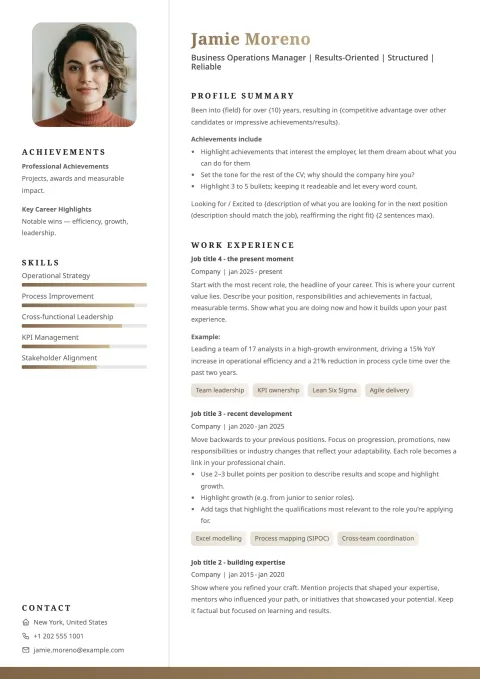


Let’s start with a brutal truth: recruiters don’t care about you. At least, not in the beginning. Not until you give them a reason to. And your resume? That’s just your first audition. Not your life story. Not a poetic memoir. Just a tidy, strategic sales pitch. Sounds harsh? Maybe. But here’s the twist: if you know how they think, you can beat them at their own game. In this article we’re going to peer into the mind of the modern headhunter. What do recruiters look for in your resume? What makes them toss it within seconds, or instead hug it like a long-lost friend? In this article you get all the insights, so you won’t just ‘submit a resume’, but will craft a truly brilliant document.
Why recruiters don’t care about you (at first)
It sounds a little harsh, we know. But a recruiter doesn’t care about you as a person. At least not at the beginning of the process.
That’s not rudeness, it’s efficiency.
On a typical Tuesday, they may scan two hundred resumes. They’re not looking for your life story. They’re looking for a signal. A hook. A reason to pause their scrolling.
They care about filling a role. You are not a human to them in that moment. To a recruiter you are just a set of qualifications, skills and experiences that either tick the boxes or don’t.
They don’t have time (yet) for personal life stories, because they also have their job to do.
In the initial stage, recruiters typically spend only a few seconds scanning a resume. Yes, you read that right! It may have taken you days to make it, but they scan it in the blink of an eye.
If your resume doesn’t impact them straight away, recruiters just go on to the next one on the pile. And despite how annoying this may feel: if you had their job, you would probably do the same.
So imagine yourself as the recruiter who had to fill a certain position, what would you be looking for? And what would you immediately like to see in someone’s resume?
Realize you’re not alone in this. According to this research web designers only have 50 milliseconds for that first impression!
So in summary:
Recruiters don’t see you as human
Of course they will see you as a human if they ever get in personal touch with you. However, right at the moment of scanning resumes, your document is just a set of data.Start thinking like recruiters
In order to know what recruiters look for in a resume, you need to understand their tools, their shortcuts and their mental filters. So put yourself in their shoes and imagine how they have to go through a massive pile of information.Recruiters are not evil gatekeepers
They are more like very tired doormen of a dance club trying to find the right person for the guest list of that evening.
How recruiters scan your resume in 7 seconds
Recruiters scan your resume for just a few seconds to decide if it’s worth a proper look. The exact amount of time varies in different studies, but let’s say it’s just around seven seconds. That’s very short!
It’s about the time of a good sneeze, a sip of coffee, or unlocking your phone.
This is not because recruiters are lazy or mean. It’s because their brain – like yours – is designed for speed and survival, to scan for opportunities and for red flags.
So when recruiters are faced with a flood of resumes, they fall back on cognitive shortcuts. It’s how humans deal with information overload: they skim, they filter, and make snap judgements.
All this decision-making burns mental energy and drains your brain like a dodgy phone battery. The more choices you make, the less sharp you become.
In science it’s called ‘decision fatigue’. One famous study found that judges were significantly more likely to deny parole later in the day, simply because they were mentally drained.
Amy is a recruiter for a mid-sized tech firm in Manchester. Her to-do list today is:
- Interview six candidates
- Read 127 new resumes
- Coordinate four hiring managers
- Take her kitten to the vet
Amy is smart, kind, and strongly caffeinated. She wants to find the right person for the vacancy she has to fill, but she’s also tired, overworked, and reading your resume in between video calls and some bites of her tuna sandwiches.
Her brain is doing the human equivalent of digital buffering, like a laptop with 23 tabs open. This means she has less patience for resumes that don’t get to the point and she has less mental space to decode vague statements.
Recruiter Amy: “I need a brilliant career overview that immediately jumps off the page, before my next distraction gets in the way. You can absolutely have a great story, but if it’s buried under Comic Sans and six pages of data overload, I won’t see it."
Exercises: Optimize your resume for recruiters (and ATS)
Now that you understand how recruiters like Amy review your resume, it’s time to put that knowledge into practice. We’ve prepared a few exercises to help you optimize your résumé for a recruiter’s tired eyes.
Take out your document and follow along with us. Are you starting from scratch, or looking to redo your entire resume? Use our free resume builder!
Exercise 1: See your resume through recruiter’s eyes
A recruiter like Amy doesn’t know you, nor your career or what you really want in life. To make sure your resume passes the 7-second scan, you need to test it with people, just like her: strangers, or at least people that don’t know you well.
Step 1: Find a fresh pair of eyes
Ask someone who barely knows your background to look at your resume. Don’t hesitate to do so! It’s part of taking control over your career and most people would love to help you forward. Maybe it even leads to new interesting contacts (or a job)!
These ‘strangers’ could be:
- A LinkedIn connection who isn’t a close colleague
- Someone from a different industry or department
- Or even a friend of a friend of a friend
→ Find at least three different people to have a broader overview of feedback
Step 2: Run the 7-second resume test
Give the people from step 1 exactly 7 seconds to glance at your resume (set a timer!). After 7 seconds, close the document and ask:
- What stuck in your mind?
- What do you think this person does?
- Would you invite them to an interview? Why or why not?
- Was anything confusing or unclear?
→ If you feel your respondents could be biased, add one or more random resumes to the test and delete your details, like your name and picture. Now you’re even more sure they’ll give honest and solid answers.
Step 3: Think like a recruiter
Grab someone else’s resume - ideally from a different field - and do the 7-second scan yourself. Ask the same questions. This shows you how much impact presentation and clarity have, even without knowing the person.
→ If you ask the ‘strangers’ from step 1 to help you, offer to do the same for someone else who’s on the hunt for a new job. After the 7-second scans you can become partners-in-crime in job searching and help each other with other things, like exercises from this course.
Step 4: Review your resume with fresh eyes
Wait a day or two and then look at your own resume for just 7 seconds. Write down your immediate impressions. Fresh eyes reveal fresh insights!
→ Also have a critical look at your previous resumes (if you have those). Maybe your visuals weren’t as polished as in your current one, but there is a chance that your older, dusty resume survives the 7-second scan better! Visuals support your message and data but can’t replace them. A good resume combines a strong message and an attractive visual delivery
Why this exercise works
Your friends might think they know you, but Amy doesn’t. She’s juggling calendars, video calls, and her cat’s vet appointment.
Let’s say it like this: If your resume isn’t crystal clear to strangers who have zero context, it won’t pass her scan either.
Thin Slicing: Snap judgements from minimal information
Scientific backgroundThin slicing is the phenomenon where people form impressions in a matter of seconds (sometimes even less than six), based on very limited information.
Psychological research shows that these snap judgements can be surprisingly accurate, even in complex situations like job interviews.
Summary of the study:
The study shows that people can form quite accurate impressions of others in just a few seconds, based on small clues like facial expressions or brief behavior.
These ‘thin slices’ of information help predict how someone might behave or be judged later.
In the research, participants watched very short video clips of people - sometimes just a few seconds long - and then made judgements about their personality or abilities.
Remarkably, these quick impressions had the same results and matched perfectly with longer, more detailed assessments.
Why it matters for your resume:
Recruiters like Amy often make quick decisions without reading every word. Your resume needs to clearly and powerfully communicate who you are and what you offer, in such a way that this ‘virtual scan’ makes an instant impact.
→ Recruiters are usually very skilled at thin slicing. They don’t always need a lot of information to get a good sense of a candidate. First impressions really matter, even from a quick glance at a resume. So, those first few seconds can make all the difference.
Exercise 2: Optimize your resume for recruiters (and win Amy’s heart)
Recruiters operate by recognizing patterns. So do their digital brothers: the Applicant Tracking Systems (ATS).
Applicant tracking systems are software tools. They filter and rank the most relevant candidates by matching your resume to the job application.
The following matrix is a visual overview of how recruiters or ATS work. It shows you their tactics, what exactly they do and how you can best respond to it.
| Recruiter Tactic | What they do | How you can respond |
|---|---|---|
| Keyword scanning | Using CTRL+F or ATS filters | Use keywords from the job post |
| Visual skimming | Looking for titles/dates in seconds | Create a clean, bold layout |
| Gut feel judgement | Deciding in 10 seconds if you’re ‘serious’ | Use clarity and confidence |
| Spotting red flags | Gaps, vague titles, job hopping | Add context and consistency |
| Emotional shortcut | Seeing what ‘type’ you are | Mirror tone and vibe of the vacancy |
In the matrix above a few words are purposely highlighted in the second and third column. It shows an example of how recruiters scan through information.
Now that you have more insights in how recruiters work and what a work day of a recruiter looks like, it’s easier to put yourself in their shoes.
And that’s exactly what you’re going to do for this exercise: pretend you’re the recruiter for the dream job you want to apply for. Ask yourself:
What problem is the company trying to solve?
If the company needs a Social Media Manager, what’s the reason for that? What does the company want to achieve? Get more clients? Get better clients? Get more funding?What keywords are you searching for?
If the company wants to be more visible and get more clients, then you (as an alleged recruiter) may search in resumes for keywords like: ‘network, ‘engagement’, ‘result’, ‘profit’, ‘community’, ‘target’, ‘leadership’, ‘growth’ and ‘increase’. → as the matrix shows: recruiters or ATS usually scan for the same keywords they used in the vacancy. Use this to your advantage!What would make you stop scrolling as a recruiter?
If you had to choose someone for a job, you would probably be positively triggered by previous achievements with strong foundations. What evidence and which data would convince you?
Now look at all the feedback you got from the first exercise. Then rewrite your top three bullet points of experience. Use strong verbs, metrics, and confidence. An example of an adjustment is:
See how the adjusted sentence answers to the problem of the company. It also contains a lot of keywords the recruiter or ATS may scan for and the message is a positive trigger for a recruiter.
What Amy actually does:
“When I look at resumes, I skim the top third of the resume first. I glance at the name, title and most recent role.
If this job title has a relevance to our job description, I look for more keywords that match the vacancy. No relevance means an immediate skip.
I also check the formatting: if it looks like it’s written in a dark cave with a stick, I don’t even have a further look. And I scan for red flags, faster than reading my teenage son’s WhatsApp messages.”
Research: How recruiters read and evaluate resumes
The matrix provided above is created to offer a clear and useful guideline. The knowledge is based on widely recognized insights into recruiter behavior and resume optimization. Such as:
Research into how recruiters scan resumes
Different eye-tracking studies, like this one, offer a perfect insight in how recruiters scan your resume and where they put their focus on.Established principles from Human Resource (HR) and User Experience User Experience (UX) deals with how people experience a system, interface or a product and how they interact with it. In this case it focuses on resumes. If your resume has a clear and consequent structure, it creates a positive user experience for the recruiter or ATS. (UX)
These fields focus on the F-pattern The F-pattern literally talks about the shape of the letter F. Eye-tracking studies found that recruiters typically scan your resume document in that shape. First they scan in a horizontal movement across the headline. Secondly they horizontally scan the subheadings. Lastly they vertically scan down the left-hand side of the document. Generally speaking recruiters tend to use this same pattern. of reading and the ATS compatibility. All our resume templates are designed according to these principles.Commonly shared best practices
In the hiring branch there are main principles, like the importance of making a strong first impression, clarity and consistency.
→ Use this knowledge to your advantage! Imagine a big ‘F’ on your resume document and make sure all your most important information is written below this reading pattern. Most Letswork resume templates have a sidebar that highlights your most impressive skills and achievements in this F-pattern.
Hidden biases (and how to beat them)
Scientific backgroundRecruiters may seem like robots while they do their work, but – fortunately – they’re still human. This means they have biases (conscious or unconscious).
A study from Princeton University (2012) shows that identical resumes with a male name were ranked higher than the same document with a female name. This counted for both male and female evaluators. Good if you’re a man, challenging if you’re a woman.
→ Use this to your advantage and make sure you keep your formatting neutral and professional. Focus on concrete data and achievements. Consider removing personal details like your date of birth or picture.
Side note: the unwritten rules for sharing personal data and adding a picture on your resume, may differ per country or culture.
Exercise 3: Humans hire humans
As told above: recruiters are still human. They have their biases, they have their busy days, they have their appointments at the vet.
So, whatever research is done and whatever advice or feedback you get, in the end of the day the process of being hired has a lot to do with the specific person that reads your resume.
You have to make this person want to meet you and humans want to meet humans. This means that, even though your resume needs to contain clear and useful data, it still needs to breathe you. Humanity. A personal touch.
This Harvard Study shows that storytelling activates the brain more deeply than plain facts. If you tell a short story or if you frame your achievement in a micro-novel, it triggers mirror neurons, it creates empathy and helps the reader to be emotionally invested.
Result: you stick better to a recruiter’s brain.
Useful format
TipFor storytelling this format is very useful: Problem → Action → Result
An example of a little story could be:
“Our intern left in tears after a rough first week → I rewrote the onboarding from scratch → A year later, she runs the boarding program herself.”
Also think about the personal brand you want to show in your resume. Such as colors, font and design.
You can even design a visual timeline, make your resume multilingual, attach a cover letter or add a background image that reflects your role. It’s all about the art of standing out with your resume.
Karl, a software developer in Munich, put a QR code on his resume that leads to a video where he explains his favorite project. The recruiter told him, “I didn’t even read the rest. I just watched your video and I knew I wanted to meet you”.
Leonore, a junior caretaker from Madeira, added a little section to her resume:
This is typical Leonore:
- I design mini-posters to welcome new employees
- I bring pastel de nata to monthly team meetings
- I give your pets new nicknames
The recruiter said: “It felt like I already knew her. She seemed the type of person that brings energy, pride, and kindness into small moments. That section sold it for me, because in our branch those gestures are very meaningful.”
Make your resume memorable (The Distinctiveness Effect)
Cognitive psychology Cognitive psychology is the field of psychology that studies how people think, learn, remember, and process information. It examines mental processes like perception, attention, memory, language, and problem-solving, helping us understand how the mind works. shows that content with a remarkable or personal touch, enhances memory. This means that information that is distinctive or resonates emotionally, is more likely to stick to the brain. This is called the Von Restorff effect.
The video that Karl added via a QR code, stimulates multiple senses. It’s visual, auditory, creative and proactive. This makes the impression of Karl very memorable.
Leonore’s quirky personal section stands out and creates a personal hook. It mirrors the vibe of the organisation and resonates with the (personal) values of the recruiter.
→ Now, write your own little memorable, quirky and outstanding story
Final thoughts: Speak the recruiter’s language
Recruiters aren’t evil or robots, they’re just fast. They scan for patterns instead of personalities.
But that’s no bad news at all. It doesn’t mean you have to shout, you just have to speak out smartly. Your RESUME isn’t a memoir, it’s a door. And you have to make someone want to walk through it.
By understanding recruiters and speaking their language, you can flip the script.
So:
- Use their scanning tactics to your advantage
- Match their tight schedule with clarity
- Touch their heart or laughing muscles
- Run the 7-second test
- Speak ‘recruiter’
You don’t need to show everything. Just enough to spark. The goal of your resume is not to tell your entire career from A to B but to get invited for that job interview. You’re not here to be perfect, you’re here to be noticed.
Make your resume whisper: “I know the game. I speak your language. And I bring something brilliant.”
Recap
- At first, recruiters don’t care about you and you can use that to your advantage
- People who understand how recruiters think create resumes that grab attention in seconds
- Tailoring your resume with strong data and personal stories makes recruiters want to meet you
In the next chapter you’ll discover…
- Why your resume format determines whether recruiters read or reject you
- The key differences between chronological, functional, and hybrid resumes (and when to use each)
- How to choose a format that instantly highlights your strengths and fits your target job
→ Go to the next chapter: How to choose the right resume format