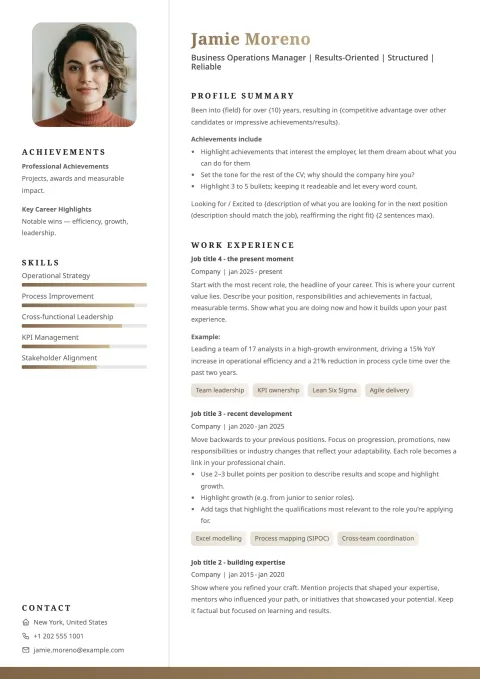


Let’s get one thing out of the way: there is no such thing as a flawless resume. Any resume has imperfections and it’s about turning them to your favor. Resumes only appear perfect when they align with what the reader expects. When the framing is right, imperfections stop mattering. Most candidates don’t miss out because of what they lack, but because they fail to communicate their strong value. An imperfect resume is rarely the problem. An unexplained resume is. Career gaps, unrelated roles, student years with no ‘real’ work, limited experience, caregiving periods, almost everyone has them. Think of it: even the person reviewing your resume likely does. So, what recruiters look for is not perfection, but a coherent story and signals of potential. The key is to frame your experiences strategically and transform your ‘weakness’ into strength. This article features seven relatable examples to show you how it’s done.
Why your resume doesn’t need to be perfect to get hired
Your resume doesn’t have to be flawless to be powerful. In fact, most people’s career paths are messy, nonlinear, and full of unexpected twists.
Yet, many candidates feel paralyzed by their gaps, career switches, student status, or periods spent caring for others.
The truth? Hiring managers do not expect perfection, they look for a meaningful narrative flow.
Let’s start with an example:
Two candidates apply for a marketing analyst role. One has a straight five year career in analytics. The other spent two years volunteering abroad, a year caring for a sick parent, and then pivoted into data.
Two months later, the recruiter remembers the second candidate. Not because its was flawless, but because it told a personal story that made sense despite the gaps.
- Volunteering reflected resourcefulness and cross-cultural communication.
- Caregiving revealed resilience and responsibility.
- The transition into data felt purposeful and deliberate, rather than random.
This resume conveys adaptability, determination and strategic thinking. All of these made the second candidate stand out.
→ That’s the power of a well-crafted imperfect resume. It tells a coherent story that reveals resilience, adaptability, and purpose.
Redemption narrative
Scientific backgroundDan P. McAdams is a leading American psychologist and professor at Northwestern University. He is renowned for his work on narrative identity and personality development.
He introduced the concept of the ‘redemption narrative’, which is the idea that people naturally frame their lives as stories in which setbacks, failures, or difficult experiences are transformed into growth, learning, or positive outcomes.
In other words: it’s not only about what happens to you, but how you interpret and integrate those experiences.
Research by McAdams shows that individuals understand their lives not as a series of disconnected events, but as a coherent narrative.
People who are able to frame challenges in this way are often perceived as more resilient, purposeful, and self-aware. Highlighting how difficulties led to learning or personal growth, is a hallmark of the redemption narrative.
This way candidates can present their experiences as meaningful and strategically valuable.
→ It’s not just what you have done that matters, but how you make sense of it.
Why resume imperfections can actually make you a stronger candidate
Your resume is not just a list of achievements, it is your career narrative. Narratives aren’t linear: they have ups, downs, pauses, and plot twists.
Professor Jerome Bruner, a cognitive psychologist, observed that humans understand information better through story structures rather than isolated facts.
Use this to your favor and turn your ‘imperfect’ facts into stories of resilience and growth. Have a look at these examples to turn ‘downfalls’ into a positive approach.
- Gaps → time away from formal employment signals reflection, growth, or unique experience.
- Student status or lack of experience → not yet entrenched in established work routines, open to learning, bringing a fresh perspective to the table.
- Career switches → demonstrates adaptability, courage, and transferable skills.
- Caring responsibilities or life events → signals empathy, responsibility, and problem-solving under pressure.
→ When your resume addresses imperfection with clarity and intention, it is a strong signal of character.
Jamal, Talent Acquisition Lead at a global logistics firm in Rotterdam, often shares this message during candidate sessions:
‘I review dozens of resumes every week. Some candidates have straightforward, linear careers, while others have gaps, sideways moves, volunteer projects, or periods caring for family members.
Interestingly, it’s often the latter whose resumes stick in my mind. Their experiences are concrete, meaningful, and demonstrate adaptability.
I can quickly explain to my team not just what these candidates did, but how they approach challenges and contribute to the organization.
That kind of narrative coherence is far more memorable than a resume that looks ‘perfect’ but comes across as predictable, flat and sometimes a little robotic.’
Now that you’re hopefully convinced that you do have a story to tell, no matter where you are in your life, let’s put this knowledge into practice.
Every resume, no matter how unconventional, contains clues about your potential, your values, and the way you solve problems. The key is to frame them in a way that a reader can instantly understand and connect with.
In the next section, we will examine seven concrete cases. Each illustrates how different types of ‘imperfections’ or unconventional experiences can be reframed strategically.
You’ll see how transferable skills, redemption narratives, and coherent storytelling can turn what might appear as weaknesses into compelling evidence of capability, purpose, and potential.
7 common resume weaknesses reframed as strengths
The seven cases that follow all start with something that many candidates worry about: an apparent weakness.
Perhaps it’s limited experience. A career change that seems unrelated. A gap in employment. Time spent caring for others, or exploring the world instead of climbing a traditional career ladder. Or simply a resume that doesn’t follow the neat, predictable path people assume employers prefer.
What makes these stories compelling is the transformation. At first glance, these situations may feel like disadvantages. Yet, when such experiences are framed thoughtfully, they often reveal qualities that organizations value highly: adaptability, initiative, resilience, curiosity, and perspective.
The shift lies not in changing the experience itself, but in recognizing the strengths it already contains.
→ All these cases are not just examples. They are lenses: ways of looking at experience that help transform what seems imperfect into something strategically powerful. Once you recognize that pattern, you start seeing similar strengths in your own story as well.
Case 1: How to write a resume with little or no experience
Students or starting professionals often worry that their resume simply looks too empty. Compared with experienced candidates, they may feel they have little to offer beyond coursework, internships, or extracurricular activities.
However, hiring managers rarely expect extensive professional experience at this stage. What they look for instead are signals of potential: initiative, responsibility, teamwork, and the ability to create impact even in small roles.
Student activities often contain exactly those signals, but they are frequently described too vaguely to stand out. This is where framing makes the difference.
Fredrik, an International Relations graduate from Copenhagen, started applying for jobs during his final year at university.
He aimed for entry-level roles in public policy. His resume listed several student activities, but the descriptions were brief and easy to overlook.
When recruiters skimmed the document, it looked like a list of passive memberships rather than active involvement. In reality, Fredrik had been far more engaged. He had coordinated debates, helped organize academic events, and led a small student team in a regional simulation conference.
Once he reframed those experiences, the same activities suddenly communicated leadership and initiative.
Before:
- Participated in moot court competitions
- Member of the Law Society
After:
- Led a team of four in a national moot court competition, achieving second place
- Organized a five-event speaker series for the Law Society, increasing attendance by 60%
→ The activities themselves didn’t change. What changed is the way they were described.
Instead of presenting himself as a passive participant, Fredrik highlighted leadership, organization, and measurable outcomes.
Suddenly the same experiences signal professional competencies rather than student hobbies. Employers can now quickly see that Fredrik can lead teams, organize events, and deliver results.
Exercise: Map transferable skills
Many students underestimate the value of their extracurricular activities. Sport clubs, volunteering, side projects, or student societies are not just an extra on your resume.
They are evidence of skills you already use and can bring into the workplace. Organizing an event, leading a team, or even coordinating schedules demonstrates responsibility, initiative, and problem-solving.
Often, these small experiences reveal big capabilities when framed strategically, turning what seems minor into a convincing signal for recruiters. This exercise also works for people further in their career.
Use aspects like your hobbies, side jobs and voluntary activities. Maybe they are a strong part of who you are and what you breathe.
Try this exercise:
- List all extracurriculars, volunteering activities, student societies, or side projects.
- Identify two or three skills each activity demonstrates.
- Rewrite your bullet points to show responsibility, initiative, or impact.
→ Small experiences often reveal big capabilities when framed strategically.
Case 2: How to explain career gaps on your resume
Career gaps can feel uncomfortable when writing a resume. Many candidates assume that any period without formal employment automatically counts as a disadvantage.
In reality, hiring managers understand that careers rarely unfold without interruption.
They hardly ever show a perfectly continuous path. People travel, take time to reflect, care for family members, have dealt with illness, or explore different interests.
What matters most is not the gap itself, but the narrative around it. A gap without explanation creates uncertainty. Instead, a gap with context can signal curiosity, growth, or initiative.
Arisha, from Kuala Lumpur, spent a year traveling through Southeast Asia before starting her technical career in infrastructure.
When she returned home to Malaysia and began applying for jobs, she worried that employers would see the year as wasted time. But the reality was different.
During her travels, Arisha frequently observed local road construction projects and became curious about how different regions approached infrastructure challenges.
She began documenting what she learned and even assisted local crews informally. Rather than writing ‘gap year’, Arisha reframed the experience as curiosity, initiative, and hands-on learning.
Before:
- Gap year
After:
- Undertook a self-directed civil engineering learning program during international travel
- Engaged with local teams and assisted on small-scale road projects
→ The gap now signals curiosity, initiative, and professional interest rather than inactivity.
Instead of an unexplained absence, Arisha’s gap year now demonstrates curiosity, initiative, and a genuine interest in her field.
For hiring managers, this provides useful context. It shows someone who actively engaged with her profession, even before formally entering it.
Case 3: How to present a career change on your resume
Career changes often make candidates nervous when writing their resume. Moving from one field to another can create the impression that previous experience is no longer relevant.
As a result, many career switchers either minimize their past work or present it as something entirely separate from the role they now want.
However, most careers are not built on completely new skills. They are built on transferable capabilities that can be applied in different contexts.
Analytical thinking, communication, research, and problem-solving often travel remarkably well across industries.
The challenge is not the career switch itself, but making the connection visible.
Nina, from Sofia, changed her career from Marketing to UX Design. After several years working in digital marketing, Nina realized that what fascinated her most was not advertising campaigns, but the way users interacted with digital platforms. She became increasingly interested in understanding how design influenced behavior and decision-making.
When Nina decided to transition into UX design, she initially struggled with how to present her background.
Her resume was filled with marketing experience, which seemed unrelated to product design. But when she looked more closely at her work, she realized that much of her marketing role had already involved analyzing user behavior and improving digital journeys.
Instead of hiding her previous experience, she reframed it.
Before:
- Managed social media campaigns and digital advertising
After:
- Conducted user behavior analysis to optimize marketing campaigns, increasing engagement by 22%
- Collaborated with designers and developers to improve user journeys on digital platforms
- Completed a professional UX design certification while leading cross-functional marketing projects
→ The experience itself remained the same. What changed was the perspective.
Instead of describing her work as marketing, Nina highlighted the user research and behavioral insights that were already part of her role.
This created a clear bridge between her past experience and her future direction. For employers, the career transition now appears thoughtful and logical rather than abrupt.
Exercise: Connect your past to your future
Career switches rarely mean starting from zero. In most cases, you already possess a range of skills and experiences that can transfer to your new field.
They simply need to be made visible. This exercise helps you uncover the connections between what you have done before and what you want to do next, so your resume tells a logical and convincing story.
If you are considering a career switch, or just dreaming about it, try this simple exercise.
- List the key responsibilities from your previous roles.
- Identify the core skills required in your target role.
- Look for overlaps between the two lists.
- Rewrite your experience to highlight those shared competencies.
→ Ask yourself one crucial question: would someone unfamiliar with my background immediately see why I am relevant for this role?
Case 4: How to include caregiving experience on your resume
Periods of caregiving are one of the most common reasons for gaps in employment. Yet, many candidates hesitate to mention them on their resume, worrying that employers may interpret them as a lack of professional commitment.
In reality, caregiving often involves complex responsibilities: planning, coordination, emotional resilience, and problem-solving under pressure.
These capabilities are highly relevant in many professional environments. The challenge is to describe the experience in a way that recognizes its real responsibilities and skills.
Lucius, an IT Support Specialist from Santiago, had been working as a junior IT Support Technician when his father became seriously ill.
For nearly eighteen months, he stepped away from his job to help manage his father’s care.
When he began applying for positions again, Lucius worried that the gap would overshadow his technical experience.
His first instinct was to leave the period unexplained. But during that time, Lucius had actually remained quite active.
While caring for his father, he also helped several elderly neighbors with their computer systems, solving technical issues remotely and setting up more reliable home networks.
By acknowledging these activities, he was able to reframe the period more constructively.
Before:
- Employment gap (2021–2022)
After:
- Coordinated complex caregiving schedules and healthcare logistics for a family member
- Provided remote IT troubleshooting and system setup for multiple households, reducing recurring technical issues
→ All his activities were reframed in a very constructive way.
Instead of presenting the period as empty time, Lucius highlighted the responsibilities and skills involved.
The gap now communicates organization, reliability, and technical problem-solving rather than absence. Employers can also see that he remained engaged and capable during a challenging period.
Case 5: How to turn volunteer work into resume experience
Volunteering is often described modestly on a resume. Candidates may assume that unpaid work carries less professional weight than formal employment.
The opposite is true.
Volunteering frequently involves significant responsibilities: coordinating teams, managing projects, communicating across cultures, and working with limited resources.
It also shows that you were driven by motivation other than money or payment. It can show a strong intrinsic drive. When framed clearly, these experiences can demonstrate initiative, social involvement and commitment.
Joaquim, a Community Project Coordinator from Lagos, spent a year volunteering after finishing university. The project was an education initiative in rural Ghana.
Initially, his resume described this experience simply as ‘volunteer work’. However, when preparing his job applications, Joaquim realized that the year had involved far more responsibility than the phrase suggested.
He had helped organize workshops, coordinate volunteers, and he had worked with local schools to develop new teaching programs.
By describing these responsibilities more precisely, the experience became far more compelling.
Before:
- Volunteered for education NGO in Ghana
After:
- Coordinated a team of eight volunteers delivering educational workshops in rural schools
- Supported program planning and logistics for initiatives reaching over 400 students
→ The difference lies in specificity and responsibility.
Instead of leaving his volunteer work out of the spotlight, Joaquim decided to give it the importance it deserves.
His volunteering is no longer a vague activity. It now communicates leadership, coordination, and project management in a cross-cultural environment.
Exercise: Turn life experience into professional skills
Not all valuable experience comes from formal employment. Periods spent volunteering, caring for family members, organizing community initiatives or supporting others, often involve real responsibilities and complex skills.
Often, the skills developed during these moments are more substantial than they initially appear. The challenge is recognizing these abilities and describing them in a professional way.
This exercise helps you translate life experience into language that employers understand.
- Think about a period in your life that does not appear as a traditional job on your resume (for example caregiving, volunteering, community work, or personal projects).
- List the responsibilities you had during that time.
- Identify the skills those responsibilities required (for example planning, communication, problem-solving, coordination, or resilience).
- Rewrite the experience as one or two short resume bullet points that highlight responsibility and impact.
→ Ask yourself: what did this experience teach me that is relevant in a professional environment? What would someone else say I became better at during this period?.
Case 6: How to structure a non-linear career path on your resume
Not every career follows a straight line. Many professionals move across different industries before discovering where their strengths and interests align.
When these transitions are presented as unrelated steps, the resume may appear scattered. But often there is an underlying thread connecting the roles. This may be a recurring skill or way of thinking.
Identifying that thread can transform a seemingly fragmented resume into a coherent professional narrative.
Samira, a Data Analyst from Casablanca, initially found it difficult to explain her career path.
She had started in accounting, later worked as a mathematics tutor, and eventually began analyzing data for small businesses as a freelancer.
When she applied for a full-time data analyst role, she worried that recruiters would see her resume as unfocused.
But when Samira looked more closely at her roles, a clear pattern emerged: every position involved working with numbers, identifying patterns, and helping others make decisions based on data.
She decided to organize her resume around that theme.
Before:
- Accounting assistant
- Mathematics tutor
- Freelance consultant
After:
- Applied analytical and quantitative skills across finance, education, and consultancy roles
- Delivered data-driven insights that supported financial planning and operational decisions
→ The individual jobs remained the same, but the story that connects them became visible.
Instead of appearing scattered, Samira’s career now demonstrates a consistent analytical mindset.
What once looked like unrelated roles now reads as a diverse set of environments in which she developed and applied the same core capability.
Case 7: How to explain short job tenures without red flags
Candidates are often worried if they have a lot of short tenures. When someone has worked at several organizations within a short period, they may fear being perceived as unstable or unreliable.
However, in certain environments, frequent changes can also signal adaptability and accelerated learning. Think of start-ups or rapidly evolving industries.
The key is to emphasize what was learned and accomplished during each period.
Svetlana, a Product Manager from Moscow, worked at three different start-ups within four years. Each company operated in a fast-changing environment where roles evolved quickly and teams remained small.
Initially, she worried that the short tenures would raise concerns among potential employers.
But when she reviewed her experience more carefully, she realized that each role had required her to launch new products, collaborate with cross-functional teams, and adapt to changing market conditions.
Rather than hiding the short stays, she highlighted the impact she made in each role.
Before:
- Product Manager – Start-up A
- Product Manager – Start-up B
- Product Manager – Start-up C
After:
- Led product launches across three early-stage companies, improving user adoption by an average of 37%
- Collaborated with engineering, design, and marketing teams to deliver product features under tight timelines
→ The short tenures remain visible, but they now illustrate speed of learning and ability to deliver results in dynamic environments. Instead of listing roles chronologically, you cluster your experiences by the skills or impact you demonstrated.
Instead of instability, the resume signals agility and adaptability.
It shows a professional who can enter new environments quickly, understand complex dynamics, and deliver results under pressure.
In fast-moving industries, that ability to learn and contribute rapidly is often far more valuable than simply staying in one place for a long time.
Conclusion: Answer recruiter questions before they ask
When recruiters scan a resume, they instinctively look for patterns.
When something breaks that pattern, it naturally raises questions. Whether it’s a gap, a sudden career switch, or several short roles.
This is not necessarily a problem. What matters is whether the resume provides enough context for the reader to understand what happened.
If a resume leaves these moments unexplained, the reader may start guessing and you might become a risk in their eyes. A short line of context, however, can immediately clarify the situation and keep the narrative flowing.
Exercise: Anticipate questions, answer them in your resume
This exercise helps you identify potential question marks and address them proactively, before they arise during the screening process.
Recruiters notice gaps or switches, even subconsciously. Pre-empt their questions:
- Identify experiences that might raise questions:
- Gap years
- Career switches
- Short-term roles
- Add one-line context or skill gained for each. Keep it concise.
- Make sure your narrative flows naturally, so gaps don’t feel like holes.
→ Show your resume to three people that are unfamiliar with your background. Do they understand the story behind your career path. Or do they still have unanswered questions?
Final thoughts: Your resume story matters more than perfection
Your resume does not need to be perfect to be powerful. What matters most is whether it tells a story that makes sense and highlights your potential.
Keep these ideas in mind:
- Perfection isn’t the goal, clarity is. Help the reader understand the logic behind your path.
- Every experience contains value. Gaps, switches, and side paths often reveal resilience, curiosity, and adaptability.
- Framing makes the difference. The way you describe your experiences determines how they are perceived.
- Focus on potential, not just the past. Show what your experiences say about how you think, learn, and contribute.
A strong resume is not the one without imperfections.
It is the one where the story is clear, intentional, and memorable.
It’s you, framed in your best light. So go ahead, embrace the quirks, gaps, and detours.
Your story is ready to shine.
Recap
- Your resume is more than a list of roles: it tells a story of your potential, not just your past
- If framed well, every gap, career switch, or unconventional experience signals transferable skills
- Imperfections can become strengths when highlighted thoughtfully
Apply these resume tips using our free templates
Thank you for completing our resume writing course! At this point, you’re no longer guessing, you’re making deliberate, strategic choices that strengthen your position with every application.
To help you get started quickly and confidently, we’ve created a set of free resume templates that translate these insights into clear, structured and impactful layouts.
Choose a free resume template